- Opening Hours: Monday - Friday 9 am to 5 pm

- Time Office:
Monday to Friday 9:00am - 5:00pm
- Call Us:
(302) 991-7000
- Email:
allaboutconstructionlc@gmail.com
- New Castle Ave, New Castle, 19720, Delaware, USA
- Call us!(302) 991-7000
- Mail addressallaboutconstructionlc@gmail.com
Signs Your Driveway Needs Replacement, Not Just Repair - All About Construction, LLC
Jul/26
- allaboutconstruction.de
- Blog
- July 3, 2026
- 0 Comments
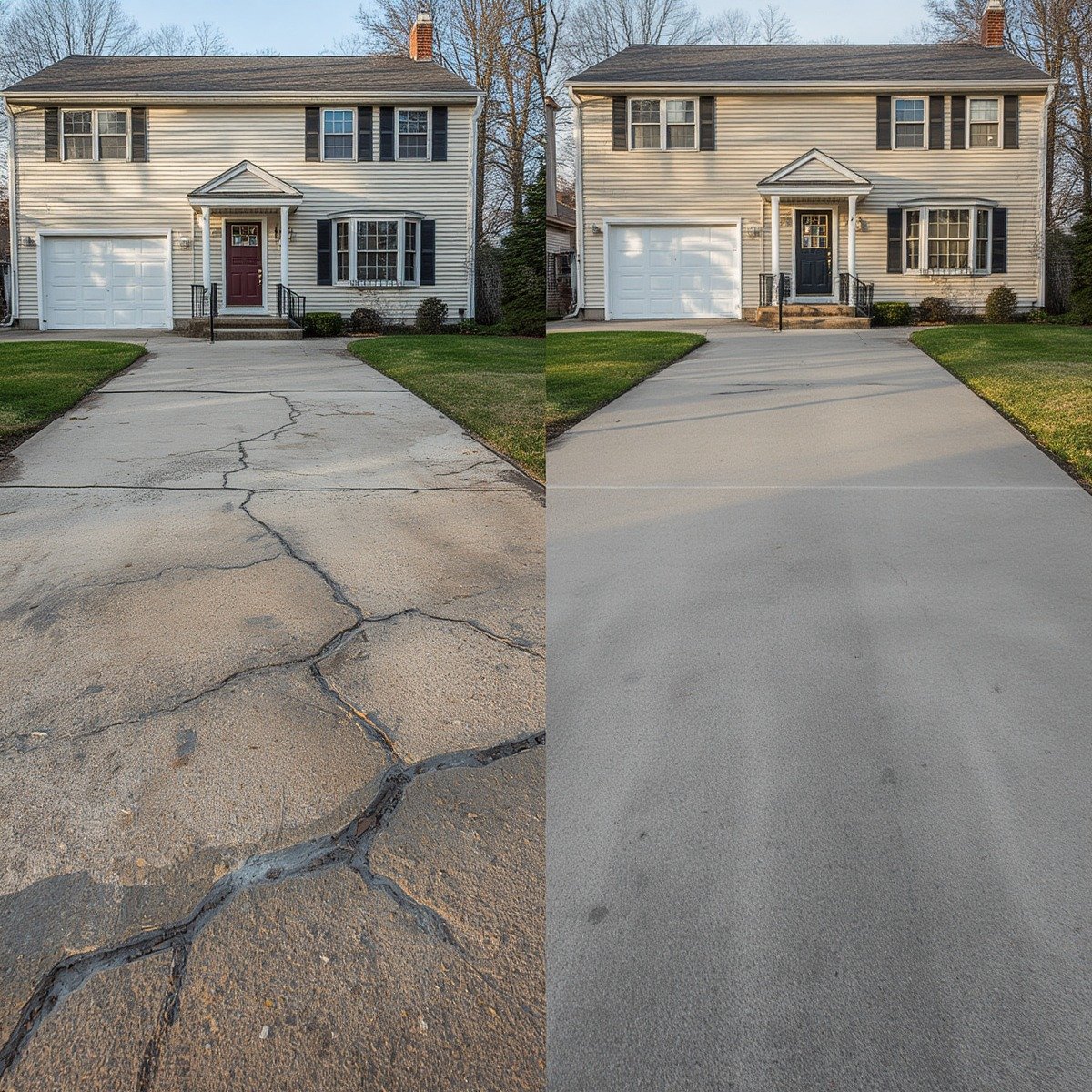
Most homeowners keep patching a problem that needs a permanent solution. Here’s how to know the difference.
Your driveway takes more daily abuse than almost any other surface around your home. Every car, every rainstorm, every freeze-thaw cycle chips away at the concrete — and most homeowners don’t notice the damage until it’s far more expensive to fix than it needed to be.
There’s a significant difference between a driveway that needs a quick patch and one that’s reached the end of its useful life. Patching a deteriorated driveway is like putting a bandage on a broken bone — it feels like progress, but it doesn’t solve the real problem underneath.
Multiple, widespread cracks are one of the first red flags. A single crack here and there is normal over time. But when you see a network of cracks spreading in multiple directions — what contractors call ‘spider cracking’ or ‘alligatoring’ — the structural integrity is compromised throughout.
Large potholes that keep coming back are another warning. If you’ve filled the same pothole twice already, the subbase beneath your driveway has shifted or eroded. Filling it a third time is money wasted on a surface that’s failing from the bottom up.
Drainage problems are often overlooked. If water consistently pools in the same spot after rain, your driveway has developed low spots — meaning the slab has settled unevenly. Standing water on concrete accelerates freeze-thaw damage dramatically during Pennsylvania, New Jersey, Maryland, and Delaware winters.
Age is a factor many homeowners underestimate. Quality concrete driveways typically last 15–20 years with proper maintenance. If yours is approaching or past that mark, even ‘minor’ issues are a sign that the entire slab is degrading below the surface.
Edges that crumble and flake away — called spalling — happen when the concrete surface breaks down from years of salt exposure, moisture, and temperature swings. Once spalling begins spreading, the concrete has lost its protective surface layer and will only continue to deteriorate faster.
The hidden cost of waiting is significant. A driveway that’s ignored long enough can damage the soil and subbase around your home’s foundation, create liability if someone trips on uneven surfaces, and dramatically reduce your curb appeal and home’s resale value.
At All About Construction LLC, we’ve been installing and replacing concrete driveways for 13+ years across Delaware, Pennsylvania, New Jersey, and Maryland. We don’t recommend replacement unless it’s truly necessary — but when it is, we do it right the first time.
💬 How old is your driveway? Drop your answer below!
📞 +1 (302) 991-7000
🌐 www.allaboutconstructions.us
All About Construction LLC — 13+ Years Expert Craftsmanship
Leave a Comment