- Opening Hours: Monday - Friday 9 am to 5 pm

- Time Office:
Monday to Friday 9:00am - 5:00pm
- Call Us:
(302) 991-7000
- Email:
allaboutconstructionlc@gmail.com
- New Castle Ave, New Castle, 19720, Delaware, USA
- Call us!(302) 991-7000
- Mail addressallaboutconstructionlc@gmail.com
Preventing Mudslides And Soil Erosion Before The Snow Comes - All About Construction, LLC
Aug/26
- allaboutconstruction.de
- Blog
- August 2, 2026
- 0 Comments
How concrete block and masonry walls protect sloping landscapes from structural shifts
For homeowners with sloped properties in Delaware, Maryland, Pennsylvania, and New Jersey, retaining walls are not a landscaping preference — they are structural necessities. A properly engineered retaining wall holds back thousands of pounds of soil, prevents erosion from destroying grade-level improvements, protects foundations from lateral soil pressure, and creates usable flat space from otherwise unworkable terrain.
What many homeowners do not fully appreciate until they face the consequences is that a retaining wall performing inadequately — whether aging and cracked, improperly designed, or installed without adequate drainage — is not merely an aesthetic problem. It is a structural liability that becomes dramatically more dangerous as rainfall saturates the soil it restrains and as freeze-thaw cycles exploit every weakness in the wall assembly.
A retaining wall that fails during a heavy rain event does not fail gradually. It fails suddenly, moving thousands of cubic feet of soil with tremendous force. The damage to structures, landscapes, and utility lines below can be extensive — and the liability for that damage falls on the property owner.
⚙️ HOW RETAINING WALLS ACTUALLY WORK — AND WHY THEY FAIL
A retaining wall resists the lateral earth pressure of the soil behind it through one of three primary mechanisms: gravity (where the wall’s own mass provides resistance), cantilever action (where the wall’s footing extends back into the soil mass, leveraging soil weight against itself), or tieback anchors (where horizontal anchors connect the wall face to stable soil or rock deeper in the hillside).
For residential applications throughout the Mid-Atlantic, concrete block segmental retaining walls and poured concrete walls are the most common systems. When properly engineered — with adequate footing depth, correct batter (backward lean), compacted backfill, and critically, a drainage system that prevents hydrostatic pressure buildup — these walls perform effectively for decades.
The failure mechanisms that engineers observe most frequently in residential retaining walls are almost universally related to inadequate drainage. When rainwater saturates the soil behind a retaining wall, the soil’s unit weight increases dramatically — saturated soil can weigh 30 to 50 percent more than dry soil of the same volume. Simultaneously, saturated soil loses much of its internal friction, reducing the force that helps it stay in place.
The combined effect is a dramatic increase in the lateral pressure the wall must resist. Walls that were adequate for dry soil conditions — and many residential retaining walls are built to minimum standards — may be grossly inadequate for the saturated conditions that develop during autumn rains and spring snowmelt.

💧 DRAINAGE: THE SINGLE MOST IMPORTANT ELEMENT
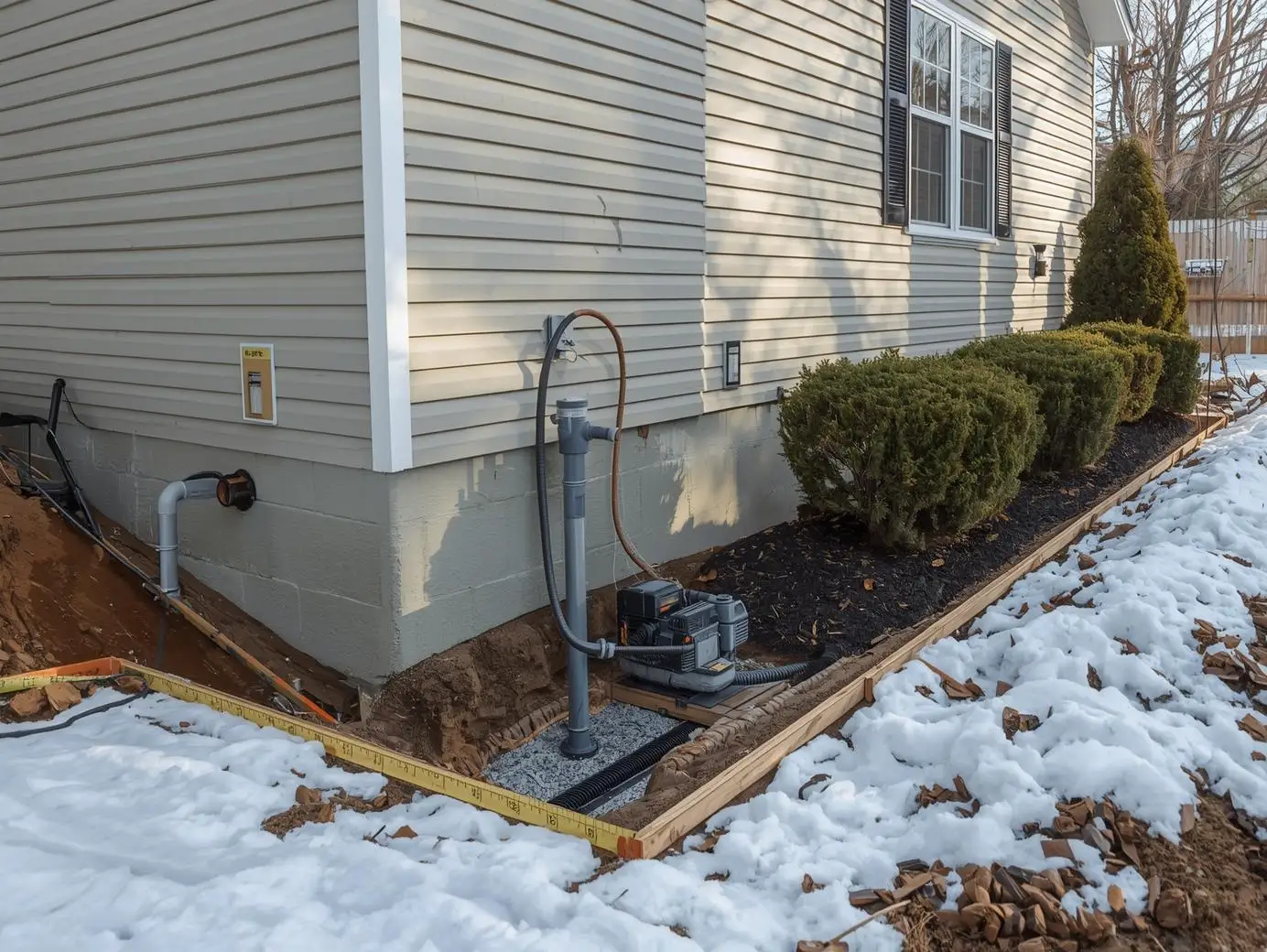
Professional retaining wall construction always includes a drainage system designed to prevent hydrostatic pressure from developing behind the wall face. This system typically consists of a layer of compacted crushed stone aggregate placed directly behind the wall, a perforated drainage pipe at the base of the aggregate layer, and weep holes or outlets in the wall face that allow collected water to escape.
When drainage systems are absent, undersized, or clogged — common in older residential retaining walls — the wall becomes a dam rather than a retaining structure. Hydrostatic pressure builds season after season, gradually overstressing the wall assembly until a failure event occurs.
In the Mid-Atlantic freeze-thaw environment, the consequences of inadequate drainage compound dramatically. Water trapped behind the wall freezes, expanding with tremendous force in the limited space behind the wall face. This freeze-expansion cycle progressively displaces block or stone units, opens joints, and advances structural failure with each passing winter.

🔍 WARNING SIGNS YOUR RETAINING WALL NEEDS ATTENTION NOW
Before the autumn rain season peaks and before winter freeze events begin, homeowners with retaining walls should conduct a thorough visual inspection:
- Leaning or tilting of the wall face is the most urgent warning sign. Any visible departure from vertical or designed batter indicates movement has occurred and structural evaluation is required immediately.
- Horizontal cracking through the wall face indicates bending stress that has exceeded the wall’s capacity. This is distinct from the minor shrinkage cracking that occurs in concrete as it cures.
- Bulging sections — areas where the wall face pushes outward from the soil pressure behind — indicate that the wall is no longer in equilibrium with the loads it restrains.
- Absent or blocked weep holes mean that drainage is not functioning. Water pressure is building behind the wall face.
- Efflorescence on the wall face indicates that water is moving through the wall material under pressure.
- Settlement or erosion at the wall base suggests that the footing may be compromised or that washout beneath the foundation has occurred.
📋 THE AUTUMN ACTION PLAN
For walls showing any of the warning signs above, professional evaluation before the rainy season peaks is essential. For walls in apparently good condition, clearing weep holes of debris and ensuring that surface drainage directs water away from the wall rather than toward it is basic autumn maintenance that significantly extends wall life.
New retaining wall construction planned for slopes that currently have no wall protection should be scheduled for completion before consistent freeze conditions arrive — both because construction in frozen ground is impractical and because an unprotected slope entering a wet winter carries real erosion and instability risk.
All About Construction LLC designs and constructs retaining walls throughout Delaware, Maryland, Pennsylvania, and New Jersey, with proper engineering, drainage integration, and the materials specification appropriate for each site’s specific soil, slope, and load conditions.
SECURE YOUR AUTUMN PROJECT WITH 13+ YEARS OF EXPERT CRAFTSMANSHIP 🏆
Don’t let winter weather compromise the structural integrity and market value of your property.
Protect your home with elite concrete and masonry solutions from All About Construction LLC.
Serving Delaware · Maryland · Pennsylvania · New Jersey
📞 +1 (302) 991-7000 | 🌐 www.allaboutconstructions.us
Leave a Comment